Time Machine Through the Canal (Part I)

Wednesday, March 7th, 2007

The first morning of our canal transit (Feb. 25th), we were up and running around the boat at 5am, en route to Balboa by 6:30, had Jan and Richard from Slipaway as well as Cousin Tito aboard by 7:30 (Ben, just in from ice-floes-on-the-lake Chicago was also aboard), and were motoring around in circles waiting for the pilot boat by 8. Then they called us and told us that we were going to be cancelled. The lady at the bank who received our payment for the canal transit two weeks before had apparently gone on vacation and forgotten to turn in the correct form to wherever it was she needed to turn it in; rumor had it that there were three boats cancelled that day in addition to ours. Defeated for the time being, we anchored off Balboa and I fed our poor crew a consolation breakfast before dropping them all back off for another day (hopefully).
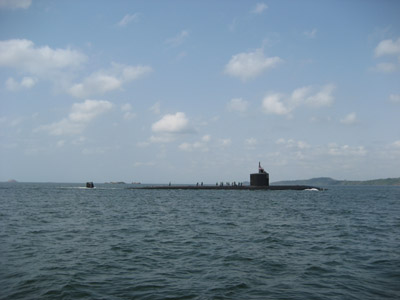
US Submarine. Panama Canal

On our way back to the Playitas anchorage, where we had a lot of explaining to do, we passed a canal-bound US attack submarine whose paperwork was not misplaced by airheaded bank clerks.

On the second morning of our supposed canal transit, after having phoned the canal scheduling office repeatedly the previous day to confirm our transit (not that this made any difference the first time since we had then twice confirmed our transit and the scheduler had gone so far as to give us the name of our advisor as well as how we were to be configured inside the locks), we were up at 5am running around the boat. Cousin Tito had been able to get one workday off but with the rescheduling, two days off (in the event that we must stay overnight in Gatun Lake) was not possible and so we picked up Gary from “Sol Surfin,” who, as a warm body with a heartbeat, was happily recruited as our fourth line handler late the night before. Once more we were en route to Balboa to pick up Jan and Richard, and Joshua was on the VHF trying to reconfirm that we were indeed actually going to go through the canal this day, the 26th.

Success! Confirmation reconfirmed. We had a time and name, once more, of our advisor (“George”) and the pilot boat would come for us in one hour. We snagged a stray mooring at Balboa and had a shockingly similar breakfast to the one before. (Nobody complained.)

We were to go through with another sailboat, “Windrider,” who had rocketed down from San Diego over the past couple of months and was making a beeline to Florida where things would be more to their liking. They spoke zero Spanish and Joshua’s general impression from having chatted with them in the bank, canal office, dock, or wherever, was that they were somewhat clueless as to what was going on. In the world. They had actually hired an agent to line up their canal transit (not that it made any difference since they got bumped the previous day as well, and had to do all the bank/canal office/scheduling errands themselves) and they had four hired “professional” line handlers aboard.

At around 8:15 (right on time!), the pilot boat came and deposited George the Advisor onto our boat. We introduced ourselves and got him set up with a large mug of coffee (black, two sugars) while he started to poke around the outskirts of our boat. Joshua and I feigned nonchalance as we watched him stoop and finger our 3/4-inch lines and eye our wee little cleats (barely large enough to accommodate such a massive line but we were told over and over again that THOU SHALT HAVE 7/8-INCH LINES for the canal transit—a size that is dead-horse-flogging overkill for our little 3-ton boat). He wrapped the lines around the cleats and Joshua went to explain what we had set up in this regard.

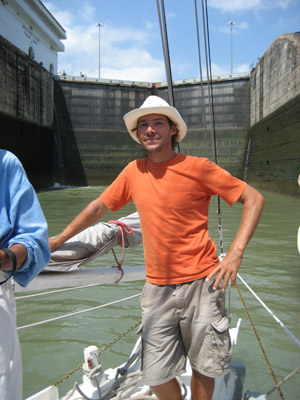
The setup is as follows (here we have Richard the Line Handler demonstrating; you can vaguely see what is going on):
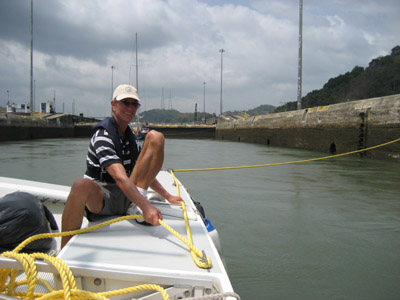
Richard. Pedro Miguel Locks Panama Canal

Joshua shackled large steel rings onto the chainplates at the extreme ends of the amas (the side thingies—pontoons) fore and aft and ran the lines through the rings down to the cleats located at the A-frames. The chainplates are extremely strong and would take the brunt of the force, the cleats would be used to lock off the ropes and work the lines, not as the main load-bearing component. Plus, with the cleats located more centrally, the line handlers would have a safer and more comfortable location to line-handle and would be less likely to fall overboard (not desirable). Joshua walked George through this and he seemed to think that the setup was good.
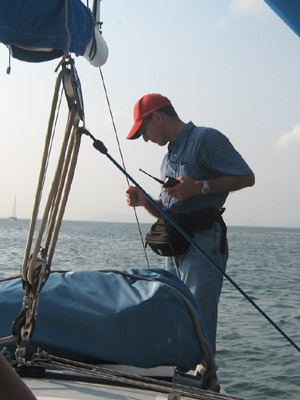
George, our canal transit advisor

[George inspects the horses.]

Then he turned his attentions to our poor outboard. “Is this your only motor?” he asked. He eyed the outboard with incredible skepticism and leaned way out to try to see how many horses. Ironically, this is our new BIG outboard of fifteen bad ones and we had up until that point been feeling like hot shit. We explained that the boat was in fact very lightweight for a sailboat of its length and that fifteen horses was fully capable of pushing us. George furrowed his brow and gazed at the motor, then the boat, then the motor, and then the boat again. “How do you control it?” he asked. Um, well, that was why there were 6 of us aboard: one captain (“Skipper,” as George came to call Joshua), four line handlers, and one “engineer,” as George eventually named me—that is, after he was convinced, at least somewhat, that we weren’t all total nutballs and the motor did in fact move the boat. We chose to hold the interesting fact that we had come down from San Francisco with a mere 6 hp until later.

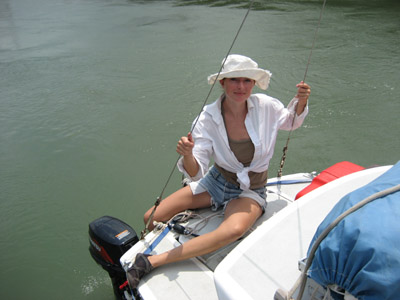
He had us drop the mooring and start an hour early for the motor up to the Miraflores entrance just in case our outboard couldn’t handle it. I took my place seated on the poop deck with my leg dangling over the stern and my hand on the control; Joshua directed me with hand signals since at the stern I couldn’t see much and could hear nothing but the motor. George kept wandering back and asking me what percentage throttle we were at. Now? How about now? He looked fairly chagrined at the scene but did not cancel us (he could call it off if he felt that our boat was not capable of getting through and he was such a stickler that we were almost worried that he might). We had of course put 8 knots down on the canal paperwork (8.5 actually, because, hell) and with 1/4 of the boat’s weight in humans aboard, a stiff 15-20 knots of wind gusting down the canal in our faces, and a couple of knots of current pouring out with the insane tides they have around here, we were going nowhere near 8 knots. More like 5 and the motor was at 75% throttle. I cranked the handle to full throttle to show him that the motor could in fact do more and George nearly had a heart attack, “NO! That’s okay! Don’t overdo it! We need that motor to get through the locks; don’t stress it too much! We don’t need to go fast right now.” He went back up to the cockpit where it was decidedly less exciting.
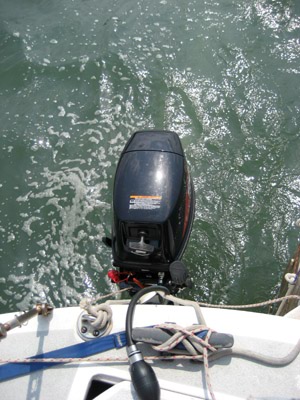
outboard motor

[My friend for the canal transit.]

cheyenne the engineer at her post

[My position for the canal transit, from which I was not to move until we were past Pedro Miguel.]

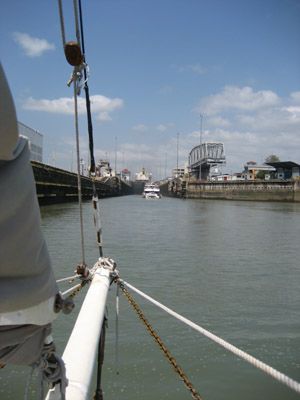
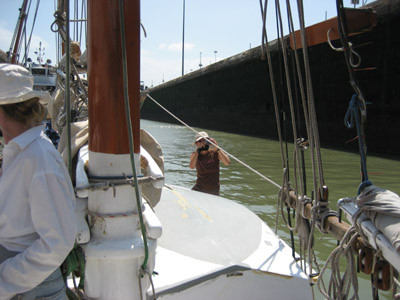
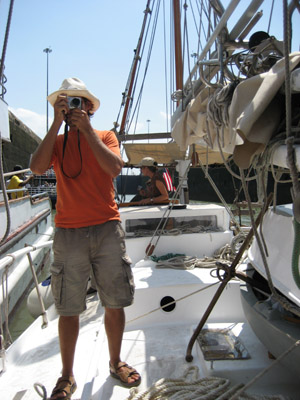
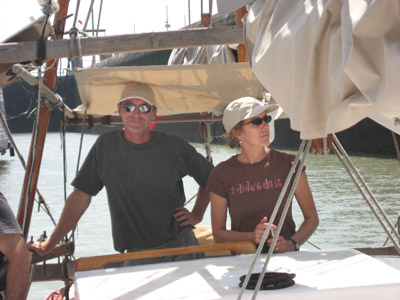
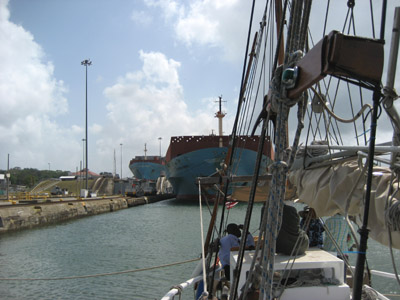
When we got to the Miraflores entrance, we motored around in circles waiting for our lock buddies (Windrider and a pilot boat). At 11:30 we entered the locks. We were tied alongside Windrider who was tied alongside the pilot boat who was tied to the wall. Once secured, the linehandlers had nothing to do but hang around taking photos. I had to stay at my post on the poop deck in case something should go wrong and I had to control the boat with the outboard; I not only controlled the throttle but had untied the outboard to have full steering capability as well. But nothing went wrong even with the flood turbulence and when we reached the top of the lock, we untied, backed up and held our position while Windrider and the pilot boat untied and moved out ahead of us into the second lock. This was not as straightforward as it sounds, actually, and we were flung around with the force of the propwash and freaky currents swirling around in the locks as soon as they moved. There was much gesturing and shouting at the engineer, who bore it stoically and managed to keep the Time Machine from dashing up against the walls thankyouverymuch. Once the other boats were secured in the second lock, we motored up and tied alongside once more.
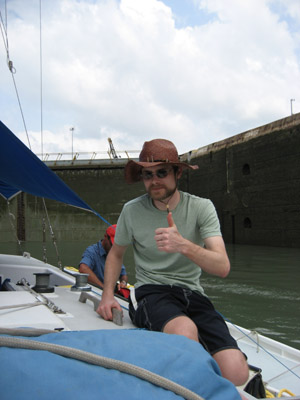
Ben says we're ready. Pedro Miguel Locks. Panama Canal

[Ben relays the message from Joshua; all systems looking good.]

Because the last undocking scene was a bit hairy, the advisors decided that once the lock was flooded and the doors opened, we would throw off Time Machine’s lines and crank the motor for all it was worth to get out of the locks ahead of the other boats. Unfortunately, Windrider’s “professional” line handlers just threw off our lines as soon as we reached the top of the lock even though the doors hadn’t even opened yet and when I saw this, I cranked the motor and steered us for the exit. Again, there was much shouting and gesturing at the engineer and I flipped the motor into hard reverse (we were right at the front of the lock to begin with and I couldn’t see what the doors were doing from my position on the stern). Then the doors opened and the swirling water spun us around sideways. Windrider and the pilot boat prudently chose this opportunity to untie and split. Meanwhile, we were sideways and heading at three knots for the back of the lock (current and major gusting wind); the line handlers were all clustered at the bow to push us off should we get too close to the wall but we managed to motor around back and forth until the bow was pointed once more for the Caribbean and we full throttled it out of the locks, waving and smiling at lock crew and cameras.
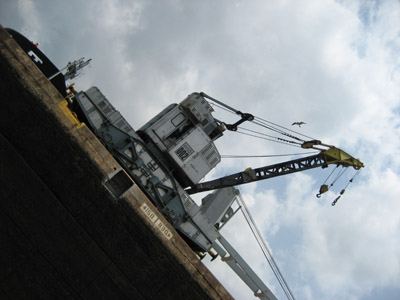
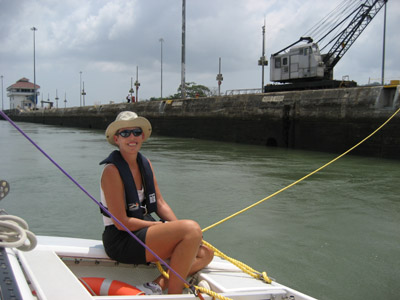
Crane. Pedro Miguel Locks. Panama Canal

[Random lock scenery viewed from beneath; this is a crane.]

After a rapid motor across the tiny lake Miraflores, we had to mark time while waiting for the Pedro Miguel locks to be ready for us. Finally we entered, this time without the pilot boat and both of us center tied in the lock. This means that each sailboat was aligned singly in the lock with four lines to the walls on either side suspending it as the water rose. Our line handlers were going to earn their keep. As the water started swirling in, the boat lurched around a little but nothing out of the ordinary and the lines and handlers had everything under control. I had nothing to do but sit on the poop babysitting the idling motor and shout things at whoever was listening (nobody).
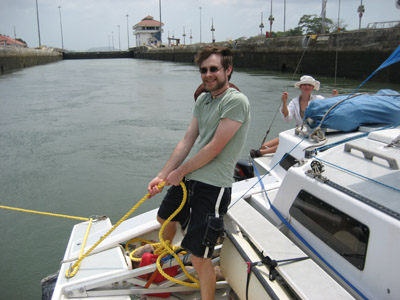
Ben Handling the lines. Pedro Miguel Locks. Panama Canal

[Ben handling the lines.]

Jan handling lines. Pedro Miguel Locks. Panama Canal

[More line-handling action from Jan.]

The lines were thrown down from the walls and pulled back up onto the boat and we motored out of the Pedro Miguel lock without incident. Finally I was relieved from motor duty and could join the rest of the crew in the cockpit where there was shade and audible conversation.

[I’ll get Part II up tomorrow!]

Casco Antiguo

Saturday, February 24th, 2007

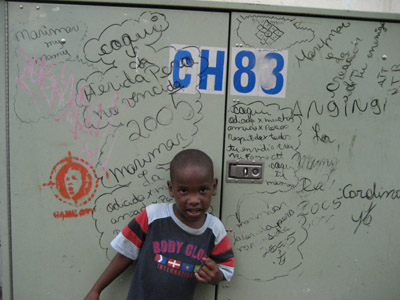
Anti-bush graffiti. Street kid. Panama City

Casco Antiguo, Panama City, Panamá.

I was trying to take a picture of the graffiti when this kid jumped into the frame and tried to extort money for the photo.


Panama Canal: Woodwind goes to the Mar Caribe

Friday, February 23rd, 2007

Waiting for the pilot boat. Pacific Side of the Panama Canal

We met Jan and Bruce at Monday Night Pizza a week before and were invited to come along as line handlers for their canal transit to the Caribbean. They crossed the canal first with Woodwind, their home-built strip-planked gaff rig, in 1989 for $50. Now it costs $600. Holy crap, I say. They swung by Time Machine at 6:30am sharp and we hopped aboard.

Jan and Jerry

Additional line-handling crew were Jerry and Nola on Moonsong from Alaska, also a boat they built themselves. We drank about ten cups of coffee while idling around waiting for the pilot boat to bring us our man for the day.

The bridge of the Americas. Panama Canal

At 10, our pilot showed up and we motored with purpose for the Bridge of the Americas and the Miraflores Locks beyond. Bruce and Jan were a little tense with this late start because the Pacific-Carib route involves a race across Gatun lake and if we got through Miraflores early, we would have a good chance of making it (Woodwind did not motor at 8 knots); if we didn’t make it through the locks early, we might not make it in time to the Gatun locks and would have to pay an additional $830 for holding up the show.

Cheyenne and Jerry

All that hurry to motor around in circles while waiting for the tourist boat with whom we were to transit the Miraflores Locks. We didn’t make it into the locks until well after 11am and it was looking like it would be iffy as far as making it across the lake in time for the Gatun Locks.

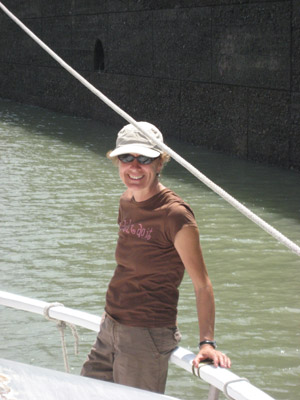
Joshua

Joshua the Line Handler.

Miraflores Locks, Panama Canal

Finally we entered the locks with two canal cruise boats packed with tourists. Our pilot decided to tie us up alongside the white tour boat for the flooding of the locks.

Miraflores Locks, Panama Canal

It was very exciting!

Miraflores Locks, Panama Canal

Tied up alongside the tour boat, we didn’t have any line handling to do at all; so we took billions of photos.

Jan and Bruce. Miraflores Locks, Panama Canal

Piece o cake, baby.

Joshua. Miraflores Locks, Panama Canal

Jan. Miraflores Locks, Panama Canal

Jerry and Nola. Miraflores Locks, Panama Canal

We chatted with the tourists from the white boat, one of whom rattled off the homeports of everyone aboard: “We got two of us from Texas, one from Connecticut, California, Washington, Illinois, Colorado, New York, New Jersey, some Canadians, and a couple from South Carolina.” “Huh,” we said.

turbulent water. Miraflores Locks, Panama Canal

Tied up alongside a large heavy power boat, the flooding locks had no effect on us whatsoever.

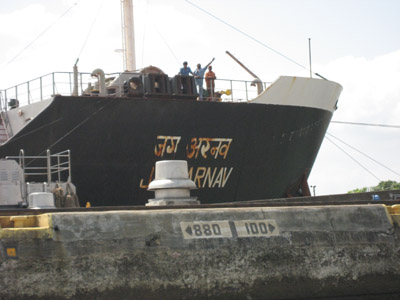
Ship. Miraflores Locks, Panama Canal

Our neighbors in the Miraflores Locks; there is always much waving and photo taking even from crew aboard the big ships.

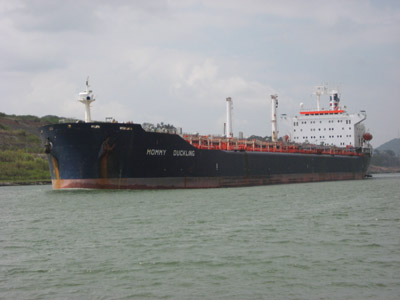
Tanker Mommy Duckling. Panama Canal

The adorable tanker, “Mommy Duckling.”

Gatun Lake. Panama Canal

It was probably 1:30 by the time we got through the Miraflores and Pedro Miguel locks and our Gatun Lock time was 4pm; with 22 miles to go against a stiff breeze, it was not looking very good for us. Bruce pushed the motor of Woodwind for all it was worth and our pilot got on the phone to request a later lock time.

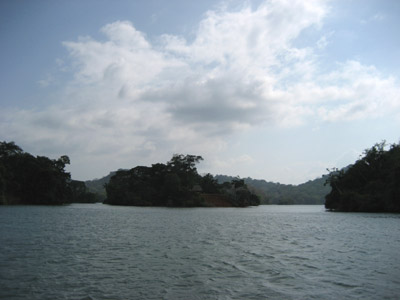
Lucky for us, the lake itself is very scenic.

Gatun Lake. Panama Canal

Anticipations high, the pilot called the locks and told them we were 15 minutes away (even though it was more like 25) but as we came out of the Banana Cut to where we could see the Gatun Locks, the tanker we were supposed to be ahead of was just beginning to maneuver into the lock. Not a chance we could get through. We would all have to spend the night in the lake and Jan and Bruce were going to be charged the late fee. There was much throwing up in the air of hands and vociferous protestation amongst those aboard.

Jan is wondering if they have enough rum aboard to pacify this crew.

Bruce serenading with a bullhorn

There was, of course, and before too long Bruce was serenading the howler monkeys with vintage television themes: “Chey-yenne, chey-yennnne! Where will youuuu be campingggg to-niiiiiiight!” (Oh brother!)

The irritation of not making the locks passed quickly really and we were all delighted to find ourselves with the engine turned off (whew!) in a tranquil freshwater lake with a sunset and howler monkeys in the trees. We all jumped overboard and splashed around in the sweet water (a huge treat for folks who have not had a proper shower in months), keeping an eye out for the crocodiles.

Gatun Locks. Panama Canal

We were all up early and ready for the pilot by dawn. Drinking coffee. Having breakfast and drinking more coffee. By the time he finally showed up at noon, we were READY.

We were first in the locks and as forward as possible, which gave us an awesome view down the locks to the Caribbean. Once again, the trip down the locks was a piece of cake.

Gatun Locks. Panama Canal

We were alone this time, suspended in the middle of the lock, with a big humongous container ship right behind us. Ayyy!


The doors opening at the end of the Gatun Locks. You can also just download the video (2 MB) if you’re having trouble with the embedded player.


Michelle in Panama

Friday, February 23rd, 2007

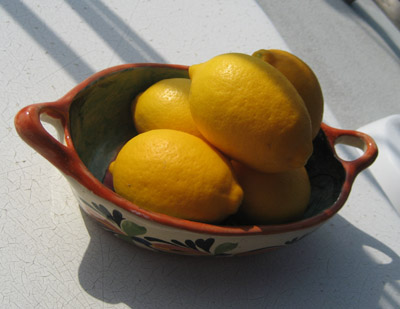
My friend Michelle visited a couple of weeks ago. She sent us an email along the lines of, “Hey, are you guys going to be around for the next eight or so days if I were to fly down?” And after we replied in the affirmative, the next email had flight dates and times. Right on! We picked her up at the Panama international airport where she was NOT arrested and thrown in prison for smuggling in Meyer Lemons (OH. MY. GOD.) packed in a large high-quality ziplock freezer bag (I was also stoked on the bag; this is because I am a huge dork) and I spent no less than three days smelling them and generally freaking out over the brilliance that is a Meyer Lemon. They just don’t care for lemons here, did I mention this? It is a shocking oversight on the part of Central America if you ask me.

meyer lemons

[Aren’t they beautiful?]

So we spent a week relaxing (i.e., not running around town in the blasting heat trying to find a DC potentiometer or somesuch, which doesn’t exist here) and playing tourist.

First in order was to introduce Michelle to the Panamanian Night Scene, which involves an inordinate amount of beer and confusion as to where to go now, where to go next, where to go for ‘el arranque’ (last drink), and where to go for all subsequent arranques. Thankfully cousin Tito was there to help us with the logistics.

Jet lag ingeniously staved off by a hangover the next morning, we headed down to Cinco de Mayo where we caught a bus on to the Miraflores Locks museum and visitors center. Here you can view the big ships (and sometimes the little sailboats) going up and down in the water. It’s really terribly exciting. We wandered around the museum which was fairly educational of course but my favorite parts were the vitrines of butterflies and other freaky bugs typically found in the area and a simulated bridge of a container ship with a wide screen that makes it look like You are the Pilot going through the locks. So you can push buttons and flip toggle switches and bark out orders on the fake phone until someone else comes into the room, and then you stand around quietly, trying to look intelligent until you finally say, “huh,” and move on to the next display.

cheyenne and michelle. miraflores locks. Panama Canal

miraflores locks. Panama Canal

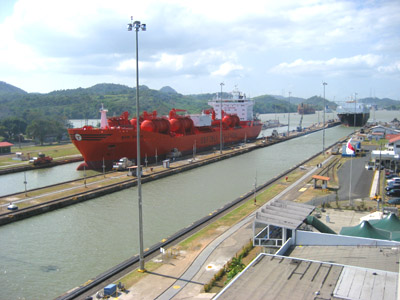
Out on the observation deck we watched a car carrier and a large tanker full of something that may have been flammable, that is, if the Danger Orange paint job and ten-foot lettering advising you to NOT use cell phones or monkey around with naked lights was any indication. After watching the ships go down to the Pacific, we went back into the freezing air conditioning to watch a bizarre educational film on the canal that was edited like that Will Smith movie where he is being stalked by a bunch of computer geeks (Enemy of the State, maybe) with a Matrix soundtrack.

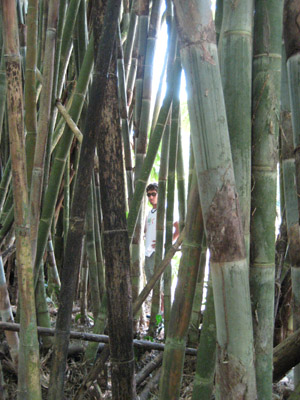
tito in the bamboo

[We went with Tito inland towards the deserted former Canal Zone town of Gamboa and on the way stopped at a botanical park and zoo. Here is Tito frolicking amongst the bamboo.]

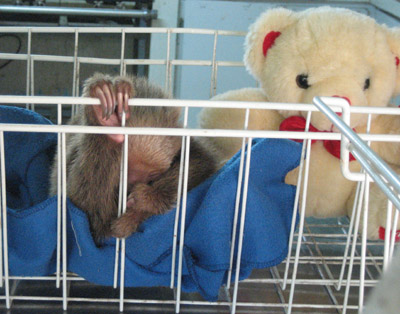
baby two-toed sloth

[Baby two-toed sloth. He was so adorable I thought I would keel over on the spot. Exceedingly lucky people in the know (Tito) can find the sloth-keeper dude and actually get to hold him but today he was sick (poor guy!) and so we could only peep at him in his crate with his teddy bear and try not to die of cute overload.]

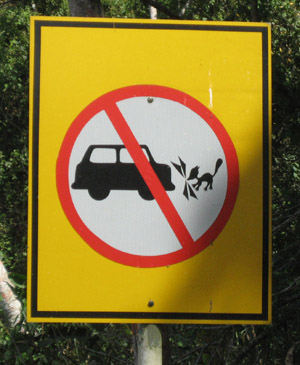
strange road sign. Panama

[One must always be careful not to hit pokey-nosed beasties with wide blunt whiskers.]

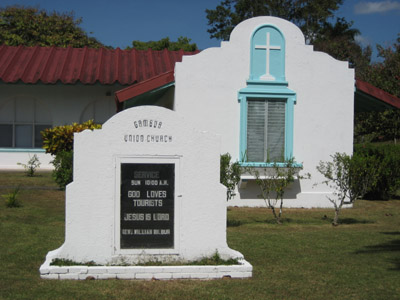
Strange sign. God loves tourists. Gamboa Panama

[God Loves Tourists in Gamboa, but evidently not Gamboa itself, which looked like it hadn’t seen a tourist since the late 80s.]

The next day we stocked the cooler with ice and pulled anchor to head out to Isla Taboga for the day. The sail over was exceedingly mellow, as opposed to the last trip out to Taboga with Tito and Rachel when it blew like snot and the seas were choppy and ugly. Then it took us about a billion years to anchor since it was a weekend and all the power boaters were floating all over the mooring field where the only quiet anchoring spot lies. “Oh, you mean it’s not always like this?” asked Rachel after we finally anchored out in some major chop. Lucky for Michelle who has a history of seasickness, it was calm and there were no power boats in the anchorage; we chucked the anchor overboard only minutes before we were able to jump over ourselves.

Michelle. Beach on Taboga, Panama

[Michelle in Taboga.]

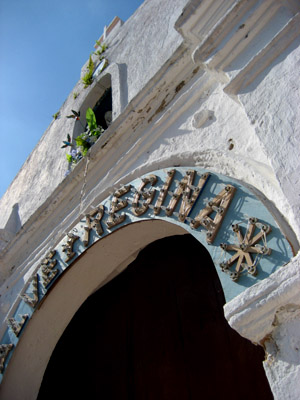
Cathedral on Taboga, Panama

[Cathedral in Taboga, which has a plaque explaining that the original foundations were constructed shortly after the village was founded in 1524. It did not mention when the Vegas remodel took place.]

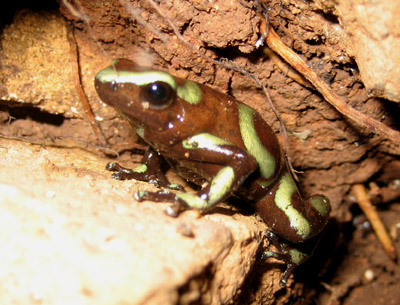
Taboga is a pretty little island with a history full of pirate-sacking and lacks only a decent anchorage. There is a small colorful town nestled on one side and more footpaths than roads. We wandered around town in the blazing heat until we wizened up and found a shady trail around the northern side of the island where there were a bunch of old WWII bunkers, collapsing with age and covered with vines and jungly overgrowth. Michelle was completely fascinated with the ruins and spent an alarming amount of brain power trying to figure out what the series of ditches, covered sunken areas, and culvert-looking things could have been used for. I stood around geeking over the preponderance of enormous morphos, among other gorgeous butterflies and wondering if it was possible to catch them (it’s pretty much not). The morphos on Taboga are particularly awesome—extremely large, opaque, and more violet blue than usual. Joshua found about a hundred leetle froggies and spent probably twenty minutes trying to get a good photo of the guys, who moved like lightning.

frog

[This was the best one.]

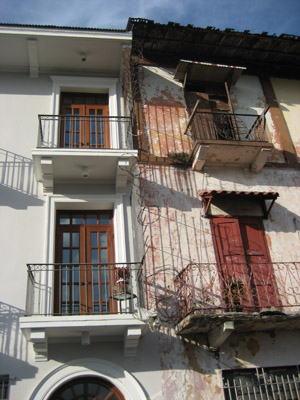
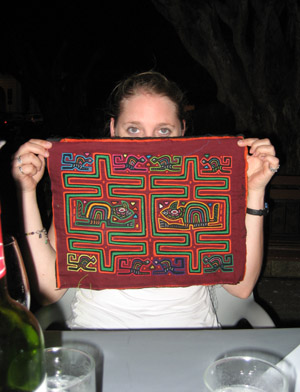
We went to Casco Antiguo and wandered around the barrio looking at the nifty buildings and the Kuna women selling their molas and seed jewelry on the sidewalks. They always tell introduce you to the “mola” like you have never seen one in your life, and you walk another fifteen feet and there is another woman with molas. “Molas,” she pronounces carefully, sweeping her arm over her display. It’s an interesting area of town with slummy buildings that look like they would surely fall down if they were not held up by the buildings on either side, which might be totally renovated and decked with varnished wooden shutters, flower boxes, and ornate iron balconies. Or it might be an empty shell just waiting force of gentrification to catch up with it.

casco antiguo, Panama City

Michelle with Mola

Michelle did not resist the temptation of the mola. We had fun. I hope she did too.


Puente de Centenario

Thursday, February 22nd, 2007

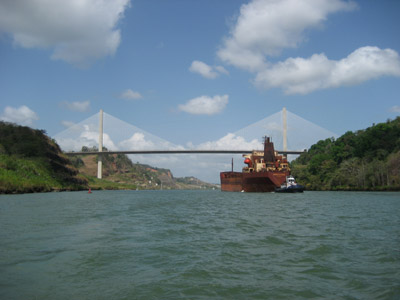
Gaillard Cut. Puete de Centenario. Panam Canal

Gaillard Cut, Panama Canal, Panamá.

Cheyenne has a bunch of posts ready for you all, but we’ve been running around doing last minute things before we leave Panama City and go through the canal. We’ll be transiting on Sunday the 25th of February. Our crew will be Jan and Richard from Slipaway, Benjamin (a friend from the states), and Cousin Tito. I know you’ve got nothing better to do so you should catch us on the live webcam. Unfortunately, we can’t give you an exact time, but it will be between 6am and noon for the Miraflores and Pedro Miguel locks. Then if all goes well, we’ll exit into the Mar Caribe through the Gatun Locks around 4 in the afternoon. Panamá Time is the same as Eastern Time (-5).


Cheyenne Weil, Joshua Coxwell