New Tyrone
Saturday, July 14th, 2007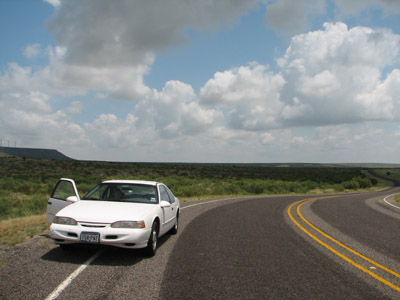
Somewhere in West Texas. Rest areas have free wireless!
Somewhere in West Texas. Rest areas have free wireless!

Padre Island National Seashore

[Top to bottom: Cutco “Trimmer” (Small), Cutco “Petit Carver” (Meduim), Shun Santoku, Shun Paring, Global Pro Paring. Sorry, but I don’t have any photos of the fish knives.]
In preparation for Boat Life, I wanted durable, dependable, reliable knives. Knives that would be able to hold their edge yet be easy to sharpen when necessary. Not too large, not unwieldy, comfortable to grasp, easy to clean. I needed knives that could cook a hot meal underway in shite weather without even being told what to make. Knives that would serve me coffee with just the right amount of sweetened condensed milk syrup in my bunk. A tall order, really, when you think about it. Here’s what I came up with:
SHUN SANTOKU (6.5-inch)
This knife is beautiful; quite possibly the most beautiful knife I’ve ever seen that you can just run out and buy from, like, Amazon. It is the perfect length for a boat because there’s not a lot of space to get fancy in the galley of a 31-foot trimaran. This is a knife I purchased specifically to bring with us because the French chef’s knife I typically used at home was about seven feet long. I had never used a santoku style knife before but I thought they were cool, and I am always enthusiastic about experimentation with sharp objects. Hours and days of exhaustive research on the subject of santokus and Japanese knives later, I chose this one.
SHUN PARING
Amazon.com had a super deal on the paring knife if you bought the santoku. It didn’t take a lot of convincing in my case.
GLOBAL PRO PARING
There’s a story behind how we obtained this knife. We were in Tokyo (it was 2002) in the section of town where you can buy all that insane cookware and plastic sushi, and we wandered into a knife shop after seeing a display of Global knives. Now, we had had our eye on the Global Sashimi knife for probably two years but they are bloody expensive in the US and so we looked (much) but did not touch. In fact, we looked whenever we might, which is why we found ourselves sucked into this Tokyo knife shop even though we didn’t expect to be able to afford anything there either.
But! Fate!! A group of Danes entered and we all greeted one another enthusiastically after recognizing each other from the ferry earlier. We wandered around this tiny shop, which seemed to be more of a wholesale type place, not a standard retail. They were called Yoshikin and carried only Global knives, and they had every possible one made. Stacks of them. We got to chatting with the Danes; it turns out they were all Ericson employees and had a special arrangement with this company. They were there to buy knives at a corporate discount of 40% and they said we should pretend we were with them to get the same deal. The shop guy already assumed we were Danish Ericson Folk anyway and so we decided that this would probably work out for us.
We pored over the options (many) and selected the much-lusted-after sashimi knife and a paring knife, for the hell of it. (I didn’t have a paring knife at all at the time.) The shop had both Global regular and Global Pro knives and the shop guy politely and emphatically explained that the Global Pro were professional grade knives with better steel and a more elaborate crafting process, not that mass marketed stuff you can find in any high-end knife shop in Denmark (cough, or the US). They were more expensive (although not extremely so) but we figured that if we were going to splurge, we should go all out and get the fancy ones. The only visual difference was that the Global had a black patina in the handle bumps; the Global Pros did not.
We had a fun experience getting this sword-sized knife on the plane back to San Francisco, but that’s another story. This is also why we ended up on the boat with only the paring knife and not the sashimi knife. (Too big.)
SMALL CUTCO
This is a very versatile serrated knife and we’ve had it forever. I will not tell you how we got it. In its defense, it had always gotten used a lot.
MEDIUM CUTCO
For some stupid reason, I decided that we would NEED a bread knife but my regular bread knife is about 16 inches long. Which is to say, longer than the trimaran galley itself and a hazard. I compromised on this knife thinking I could deal with the small loaves of bread and carve a chicken too if the opportunity came up. Well, the first fresh bread of the trip didn’t hit our boat until Isla Guanaja; kind of pathetic but we don’t have an oven and I’m particular. I probably used it all of six times in 18 months.
MAJOR FISH KNIFE
I have dealt with precious little raw meat in my life and fish least of all. Once when I was 13 or something, we went to a lake on a family vacation and I put a pole in the water. Bored after about ten seconds, I abandoned it for a good 24 hours or more. When I finally wandered by again, a small trout was twitching on the other end. I freaked out and called for help. My grandmother, who I had assumed was on my side, came trotting down to the dock, snatched up the fish, yanked the hook from its mouth, produced a knife from her apron and sliced the head clean off in less than a second. She then kneeled down on the dock, cut the fish from gaping, bleeding hole to tail, stuck a finger in, yanked out a bit of stringy blobby guts and slung them out in to the lake where they slowly sunk to the bottom. Then she took the blade and scraped it across the dead body, like petting a cat the wrong way; scales popped and zinged all over her knees. The whole operation took probably 20 seconds. Thusly, I was the appalled bringer of the breakfast bacon. It was pan-fried and served alongside the more standard morning offerings but I think mom was the only one who actually ate it.
So, I knew fishing would be involved on this trip and knives would be needed to cut them up in special ways. The least I could offer was to do my part in shopping for such a knife and I went to a shop with a humongous display of knives and asked the knife person what she recommended. I think she had larger fish in mind. This knife was more useful as a pirate prop than a functional cutting device.
MINOR FISH KNIFE
A smaller six and a half incher is actually the fish knife we used. Jeff bought it for us in Ensenada after I nearly beheaded the binnacle showing off our pirate’s booty. Turns out that we tend to catch fish when we go at least six knots, and usually much faster; this means that the seas and weather conditions are often large and sucky. And, since I am still traumatized by the lake trout, Joshua is officially in charge of turning live thrashing fish into the delicious filet. The smaller knife just worked out better in that there was less leg to cut off if he missed.
THE VERDICT
I used the Shun santoku and the Global Pro paring knife BY FAR the most. It is not an exaggeration to say the santoku was out every time any meal was prepared on the boat (twice per day for eighteen months). The major fish knife was almost never used, nor was the larger Cutco. The Shun paring was in third place and the small Cutco was a ways behind it. I think basically, only one paring knife was really necessary (an eighteen-inch galley is strictly a one-butt affair). Particularly interesting is the way the blades have held up to boat abuse. I did my best to take care of them but conditions on a boat are not always the most delicate. I wasn’t going to NOT use them for fear of damaging them.
The Global Pro steel held up excellently—far better than the Shun. Even the comparison between the two paring knives (the Global being more frequently used) shows that the Shun paring steel has a lot more wear. The Global pro knife shows almost no nicks but both the Shun knives have nicks running the entire length of the blade. I hate dull knives and so I have Joshua sharpen the knives whenever they won’t easily dice a tomato; we have very good stones (and sharpener) so I’m disinclined to say that the problem is due only to inexperienced sharpening. I probably don’t need to mention that I always use a cutting board—I favor a mesquite board—and the knives were stowed in a teak wall knife rack.
Behold the horror:

[This is a scary close up of the Shun Santoku. It is horribly pitted pretty much the entire length of the blade. I really hope I can send this to a professional and have the nicks ground out again because I dearly love this knife.]
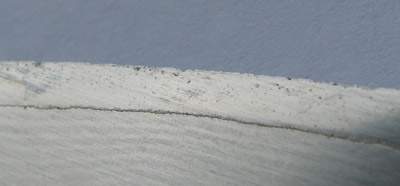
[The Shun paring knife. Man, these close ups make them look terrible!]
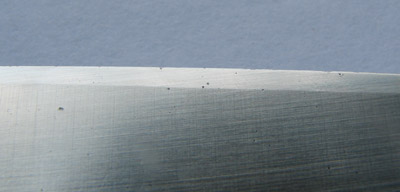
[The Global Pro paring knife, virtually free of nicks and looking great after the ordeal. This is the same scale of close-up as the above Shun photos, by the way. With some diligent sharpening, we can probably grind the few nicks out ourselves.]
Lamely, I have not been regularly updating the blog like normal. Joshua has been posting filler photos hoping nobody will notice. This past week and a half have been consumed utterly with the Family Reunion, and we have averaged maybe 35 minutes of waking time at Joshua’s dad’s place per day. So, updates have been largely nonexistent. Before the family reunion, we were doing boatwork!
THE BOATWORK
Rudder. After dragging the boat up onto the lawn at Jeff’s house, we promptly removed the rudder and broken gudgeon. And kind of stared at it for a moment. Then we decided that maybe we’d work on some other projects first. A month later we still haven’t done any work at all on it; it has just been sitting in the breezeway under the house being largely ignored, I mean, where it can dry out thoroughly. The rudder itself isn’t really that big of a deal, we are still just sort of pissed off at it. There is a small section on one edge where the fiberglass is cracked and so we’re going to cut that away, epoxy, sand, re-glass, sand, epoxy, sand, epoxy fair, sand, and paint it. A lot of work for such a small spot. That’s usually how it goes.
Also, the infamous broken gudgeon. John Williams, the owner of Gimme Samoa, is chief engineer on a 900-some foot container ship and he generously offered to weld up a new piece for us during idle hours between Hawaii and Southern California. This was a deal we could not pass up. We just got the new part in the mail and are have been fighting over who gets to sleep with it at night, it is so BEAUTIFUL!
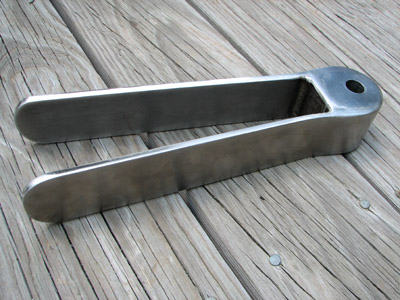
Behold the splendor. John did an awesome job and we are so happy!
Compare to the old part we had hacked together for us in Guanaja. The ends are totally sheared off (where the double arrows are); this happened during the Gulf of Mexico crossing but we had it lashed to the rudder through those little cheek blocks. This was a sketchy situation though because the rudder knocked around inside the part, widening the legs and threatening to rip again where I have a single arrow, and where it had ripped three times already. We knew the area must be pretty brittle.
Centerboard.
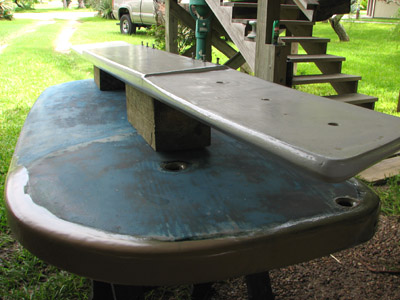
[Centerboard below with fairing epoxy ready for sanding. Again. A freshly-painted aca is balanced over it.]
When we first bought the boat and were sailing it down the Sacramento River to the San Francisco Bay, we had a minor anchoring mishap. After chucking the anchor overboard while pointing upwind, we dutifully attempted to reverse downwind to set it; however, the opposing current was so strong that we were spun around in a circle, running over our anchor line and wrapping it around the centerboard, which we forgot to raise before anchoring (oops). The damage was a one-inch notch in our centerboard, which we patched up “temporarily†with some Splash Zone-like epoxy putty hoping it would stay put. It held out for a very long time, until a few months ago actually, when we accidentally did the exact same thing, popping the epoxy right back out of that notch. We figured it was time to remove the board and repair the notch for real and see if there was any other damage. We dug a hole under the boat and dropped the board out from underneath. Like the rudder, there were some cracks in the fiberglass along the leading edge of the board so we ground it all off, did the whole sand/epoxy/glass/sand/etc. number, and now we just need to paint the thing. And put it back up inside the boat, which I seem to remember being much more difficult than removing it the last time we did this…
Acas. All four of the acas (the cross pieces—not the A-frame structural bits) have fiberglass cracks. They are pretty minor, but they look ugly and are one of the first things you notice when climbing aboard the boat. To fix them, we just need to remove them (one actually, Jeff fixed without taking it off the boat at all), grind/epoxy/glass/sand/fair/whatever to fix the cracks, then repaint and replace. Unfortunately, with the boat sitting out of the water, we are afraid to remove more than one piece at a time (in case the boat torques a little and we can’t get the bolts back into place). This is a pain in the ass in that we must do each one separately, one at a time. We just finished the paint and have two to go.
Hatch Covers.
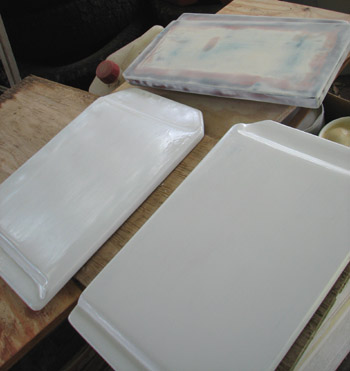
The lazarette covers in the very bow and stern of the boat had major fiberglass crackage and were in general, hugely ugly and in danger of rotting. We removed them, did some prying and grinding to get rid of some of the totally gross glass and layer of rotting wood underneath on the edge and then wondered if we should just start from scratch constructing new ones. After realizing that this was probably a lame idea (the wood was fine everywhere else—just not on the edges), I removed the remaining glass from all edges, ground off all soft wood, and peeled up any sort of delaminating bits, wedging shims underneath so the air could get in and dry it out. Then I laid them out in the sun for a week. Once they were satisfactorily dry, we re-epoxied down the good-condition glass on the tops of the boards, then reglassed all four edges of all the hatch covers. This took about a million years. Much sanding and exoxy fairing and foul language later, they look better than I think they ever have and are ready for paint. Um, all except one set, which we sort of forgot to check for size after I ground away soft wood on the edges—we need to make them a little wider (only 1/8 inch but still, what a hassle); I think we will just add some more fiberglass layers, refair it, and call it good.
Varnishing.
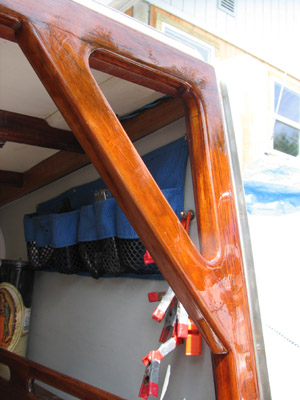
[So. Shiny.]
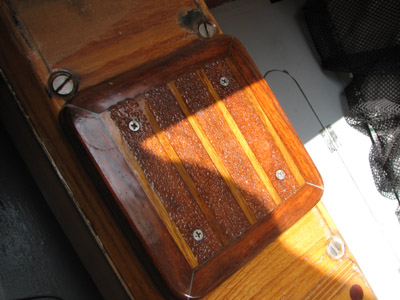
The companionway handles used to be lovely varnished glowing wood; however, after two years of rubbing sweaty hands covered with deet and sunscreen over them every time we got in and out of the cabin, the varnish was goopy and the handles were darkened and ugly. In addition, there were a couple other little pieces of wood (like in front of the sink) that had some varnish rubbed off. I removed these, sanded off all varnish entirely, then clear epoxied, sanded, and varnished them. I ended up painting four coats of varnish in the end, although I had intended to only do three (sanding between coats gets old fast). Unfortunately, right after I painted the supposedly third and final coat, the wind shifted, upsetting a large amount of fresh sawdust from the upstairs construction. This swarm of sawdust navigated down the stairs, circumnavigated the house to the downstairs breezeway, and evenly coated all my wet varnish. I couldn’t believe my eyes when I saw it. After much grumbling, I finally drove my pile of sticks to Tucker’s house to do the new final coat in his garage. They are back in place in the cabin and look really really nice. Varnish is a wonderful thing.
Minikeel. There was a three or four inch crack in the fiberglass in the minikeel. We weren’t sure if it was a small or large issue but figured it ought to be ground it away to make sure the wood underneath was still good. Grinding was interesting in that we discovered a little pocket of water under the glass but we also found that the wood underneath was still totally solid. Joshua ground away a huge swath of glass maybe three feet long on both sides to make sure there weren’t any other hidden water hidey holes and we let this dry out for a week or so. Joshua then laid new glass over the whole area. It now needs a final sand and paint.
Beneath the minikeel was a wormshoe. This is a piece of wood, usually unfinished but in our case, neatly glassed and painted with beveled edges, meant as a sacrificial snack for would-be pests and boring critters. We pried the remains of this gnarly bit off with a crowbar and trashed the thing. It was fully rotted out and perforated with holes. Wormholes, presumably. The minikeel was in excellent shape (aside from the glassy bit above I mentioned) so I guess it did its job.
Catwalk Supports.
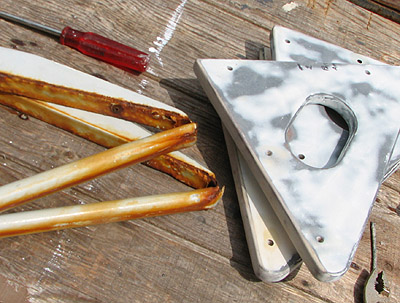
[Just in case you weren’t sure, the old pieces are on the left, bleeding rust. The new pieces are faired and ready for paint.]
These were originally made from ferrous metal and then painted to stave off rust. Clearly, this did not work out so well and the rust had oozed orange stripes down the boat. Finally, in the last couple of months, they rusted through completely and needed to be replaced totally. Joshua’s dad decided he would make new ones from scratch from plywood, so he partook in the cut/sand/epoxy/sand/fair/sand/drill holes/epoxy/etc. fun. They are ready for paint now and are looking great. I’m particularly happy that they will no longer drip nasty gunk down the boat. There is a product called “Sno-bowl†(like Tilex) that was recommended for the rust stains and it worked great! (We were highly skeptical that the stains would come off.)
Cockpit Seat. There was a tiny hole in the drainhole of the cockpit seat and eventually, this leaked water into the seat and delaminated the fiberglass (and possibly the plywood). We decided to add a hardwood support underneath, drill holes into the top of the seat to dry it out, then inject it with penetrating epoxy and regular filler epoxy after. I made a piece for the support and drilled a zillion little holes in the seat. About three days later, right around the time it was nearing bone dryness and was about for filling, it began to rain. We freaked out, blue taped up the holes as best as we could, and rigged a tarp over the area to keep the water off. Unfortunately, when it rains here, it comes down either sideways and upside down or as a solid lake—and it tends to last for days on end. In this case, about seven. Water got on the seat. Water mocked my blue tape and got in my holes. CRAP!!
To make a long story short, the seat is drying out once more. We’ll hopefully get to it soon here. Hopefully it won’t rain for a few days.
Bottom Paint. Joshua sanded the bottom and it’s essentially ready for paint when we are ready to apply it. I plan to tape off the main hull adding a couple of inches to the water line. When we were traveling and loaded down, the line was exactly at the water level, which made us feel fat. When empty, of course, the main hull has around three or four inches to spare.
Misc Leaks. There are a couple of drippy drips that happen when it pours outside. One is forward where our running light sits—we need to goop that sucker up with some marine silicon. Also, checking the windows might be a good idea before we leave the boat. We also have a leak from the boom track, which will require us to remove it, dry it out for a day (if necessary), re-goop and bolt the thing back down. We were procrastinating on these minor tasks during the nice weather and then of course, we couldn’t do anything when it was raining…

Copano Cove, Texas