Guanaja

Monday, April 9th, 2007
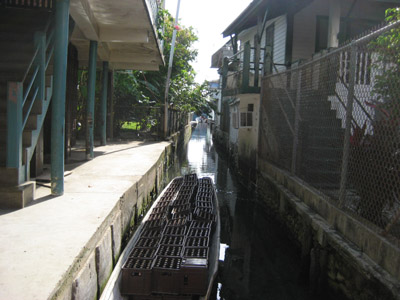
canals. Guanaja, Honduras

[Looks just like Venice, right?]

The island is sparsely populated in that the majority of the people here live on one small cay, every square inch of which is covered, spilling boardwalks and stilt-houses far out beyond the confines of any actual land. There is a sizable fishing community here and lots of working boats, not working. Probably because it is no longer shrimp/lobster/everythingyummy season. Poor us.

Anchored local boat. Guanaja, Honduras

[Tranquil Caribbean scene. What you can’t see: no-see-ums. Right.]

The main island has a few local residents but for the most part is populated by expats, of which there is a significant population. There are a few hints here and there of resorty development that evidently was abandoned when hurricane Mitch came through because, hey shit dude, hurricanes? Just about everyone we have met speaks both English and Spanish (I speak Spanish because it’s good practice and I can’t understand the local English anyway) and is very friendly. Ronnie, a retiree from Florida who is building a house here on the beach near the anchorage, nearly slays us with his hospitality every time we see him, inviting us to beach our dinghy on his property, fill our water jugs from his hose, use his cell phone if we need to call our family in the states, come over around dinnertime to be fed in case we run out of food on our boat. Just nice.
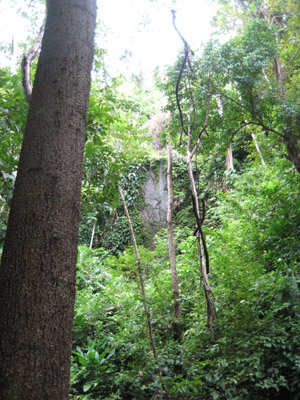
Jungle. Guanaja, Honduras

[Pretty jungle trees.]

We spent the first couple of days catching up on more sleep than we actually missed during the passage between Vivorillos and Guanaja and doing mild hiking/bushwhacking (this time I was prepared with closed-toed shoes). We were told where a waterfall trail was and damned if the trail was actually a cleared path leading to a real waterfall containing water that actually dropped from a spot up high to a spot lower down. We have been suckered into too many “waterfall hikes” in the past few years to take such things for granted.

After Providencia I was pretty gung-ho on the bushwhacking, particularly since on Guanaja there are no ant bushes. There are, however, these, which we spotted swimming towards us in a shallow pool of water:
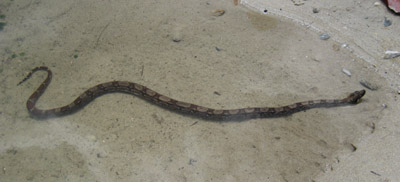
Red Tailed Boa. Guanaja, Honduras

[Poisonous viper Harmless red tailed boa. How nice. Will be doing less bushwhacking in the future.]

Seeing as how we’re Texas Bound and all that, I dug out War and Peace because I was really feeling like I hadn’t read any books lately with enough ‘Alexei’s in them. (Turns out W&P has not a single major character with the name Alexei! How about that?) Suddenly I made a lot of progress in the book, finished it in fact, except for the Second Epilogue because I needed a rest from all that historical philosophizing, when a UTI came barreling down on me with all the subtlety of a USCG cutter. I have been laying around the cabin the last few days feeling sorry for myself and hiding from the no-see-ums and sun because the antibiotics I put myself on have the glorious side effect, among others even more glorious, of making one extra sun sensitive. I just can’t decide if, Antibiotics: miracle of the modern age; or, Antibiotics: evil havoc-wreaking hellspawn. Hard call. Last time I took them was in 2001 and it took me about two days to decide that I’d really rather just have the illness of which they were supposed to cure me.

One other thing, now that I’ve geared up to fully auto Rant Mode. I have been reading a great volume of books over the last few days and I can’t believe how many reviewers feel the need to draw comparisons to Catcher in the Rye (particularly when none exist). The last few books we’ve read are: Vernon God Little, Number 9 Dream, Winter in the Blood, Elvis, Jesus and Coca-Cola and every single one of them says something like, “Holden Caulfield all over again,” or , “this generation’s Catcher in the Rye” (this, fer god’s sake, on the back cover of a noir about a 30-something Jewish country-western singer/amateur detective named Kinky). Makes you wonder if they even read the book they are reviewing (not that I don’t often wonder this even when they aren’t conjuring up the holy CintheR). Maybe they’ve never read Catcher in the Rye. First person narrative? Holden Caulfield all the way! Takes place in New York City? SO CintheR, absolutely. Maybe it’s just been too long since I read it myself; I certainly don’t remember blowing flowers and gold ribbons out my mouth about it. Just a pretty good book. Whatever.

We check out of Honduras today and move on tomorrow for Mexico. It should take us two days and one night and hopefully we’ll get there late Wednesday afternoon, which should be right about the time that my fresh crop of no-see-um bites bloom into fully operational battlestations of itchy evil. Will keep all posted.
Rudder McBrokersons

Tuesday, April 3rd, 2007

We barely had time to delight in the first downwind sail we’ve had since Huatulco when the seas grew irritatingly large and the rudder broke.

Crap.

I had been trying to take a morning nap after a night of no sleep (I never get more than two hours or so when underway) but was having trouble due to the uncomfortable way the boat was weaving back and forth down the waves. Just as I got up, something happened and Joshua lost control completely of the steering. The boat rounded up into the wind and just stood there, teetertottering over the oncoming waves. We pulled the centerboard down in hopes of having some control (we sometimes run with it up when running due downwind/downsea) and Joshua went back to inspect the problem area.

“The rudder is totally trashed,” came the report. “Like how trashed? TRASHED trashed? Or still sort of functional trashed?” I put my harness on and went back to see for myself.

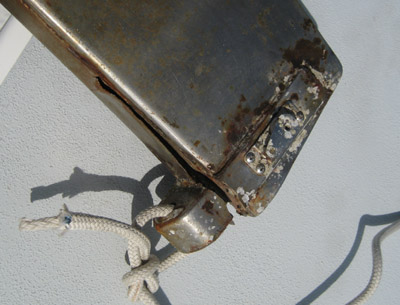
searunner 31 broken kick-up rudder

[TRASHED trashed, but still sort of functional trashed.]

Sea and wind conditions were 6-8 feet and 25 knots, occasionally gusting to 30. I was pissed about the rudder and snuffled irritatedly in the cockpit while Joshua the fearless non-worrier made fried rice for breakfast. We were actually really lucky to be only 14 miles out from Guanaja. Unfortunately, it was all downwind sailing, which places more stress on the rudder than upwind sailing.

This boat does not have a typical skeg rudder but rather an extra-long kick-up rudder housed in a stainless box. The box is attached to the stern and the rudder is bolted at a pivot point above and held down in place with a rope. Because this type of rudder sticks down below the keel, it is particularly vulnerable so we made a fuse out of some fishing test so in case we ever hit something; then it would break and the rudder would float harmlessly to the surface to trail behind us. Hopefully we wouldn’t need to, say, steer if this ever happened. The rudder box has always been suspect in that it cracked shortly after we left San Francisco (we had it welded in Ensenada) and again around Huatulco (we had it welded again there). We are not sure what happened this time; possibly we hit a submerged log and the fuse broke or we hit nothing and the fuse broke anyway, then the following seas pushed the floating rudder across and ripped the rudder box wide open. Now the rudder is attached only at the pin (where it is in danger of twisting sideways and causing further damage) and the lower part just sloshes alarmingly free.

We went with the mainsail up only and I steered by suggestion. “Left.” “More left.” “Goddammit!” Each gust was causing the boat to head up and it was very difficult to get back to where we wanted to be without putting any pressure on the rudder. Joshua put up the storm jib and pulled it in tightly; now when the gust caused us to head up, the wind would push against the jib and have us back on course (mostly) shortly thereafter. We wobbled our way to Guanaja making around 5 to 6 knots and happily rounded the reefs to the anchorage after only a few nerve-fraying hours.

Again, we are lucky in that Guanaja has a large fleet of working fishing boats. A welder was recommended to us almost immediately and tomorrow we will take our broken rudder box to him and see what we can do. We will not be able to just weld the box back together at this point but we think we can cut the bottom part off and fabricate a new piece to bolt directly to the lower part of the rudder itself.

So now we’re Destination: Texas, where Joshua’s family lives and we can haul out and fix stuff. Among other things (an irritating leak in the centerboard trunk will require attention soon) we will see about building a new, more solid rudder and ditch this kick-up bullshit altogether.


Vivorillos/Vivarillos/Vivarios/Vivorios

Thursday, March 29th, 2007

Local rumor had it that there had been some pirate and Nicaraguan Navy activity lately between Providencia and Guanaja. We asked for more details about the Nicaraguan Navy because the cruisers all seemed pretty concerned about this part but it turns out they just board you and check your documents. “And then what?” “That’s all,” they say, but oh my such a terrible imposition when underway and blahblahblah. Safety in numbers and all that good logic and so we planned to sail the passage with Velella and keep at least in radio contact since our boats were not very equal speed-wise (we can sail fast but not motor and would be tacking; they can sail slower but motor fast and in a more beneficial direction). Honestly I don’t know what we would do aside from make a lot of radio chatter, perhaps conjure up our friends ‘Summer Wind’ and ‘Toucan Tri’ to appear a larger group. This is evidently what others have done and it seems to have scared off the random pirate of opportunity now and again. We both ran dark and called each other every few hours to check positions.

Obviously we didn’t get attacked by pirates and only saw one suspicious boat which altered its course, followed us for an hour or so, then turned and went on its way. As it was a fairly large, we figured it was probably the Nicaraguan Navy. Our second day was rougher than the first and the wind kept shifting so that it was always a beat on the nose even after we turned more west. Joshua mentioned already how one of the inspection port lids broke off somehow allowing water to gush into the ama. We bailed a shitload of water out of the ama and moved much better after that. The night was long and filled with squalls, one after another, where the wind would drop, blast with force, drop, build, etc. We spent the entire time pretty much soaked either by salt spray, which was abundant, or rain, which was torrential. Adding to the fun was a delicate shoal situation where we had to maintain a fairly exact course to pass between reefs, pitch-black darkness, and a freshly burned-out compass light. So we had to keep flipping on the GPS to tell what direction we were moving. We made good time with all the wind and arrived at the Vivorillos at around 3am; Joshua hove to and the wind was howling. For my watch I had only to babysit the boat, watch for ships, make sure it didn’t get going too fast when a squall passed (we made sometimes five knots but usually kept it around two), and hold on because it was bouncy. By the time it was light enough to see where we were, we had passed Vivorillos by five miles and had to beat back up to it; Joshua was totally appalled and he complained bitterly the whole way to the anchorage.

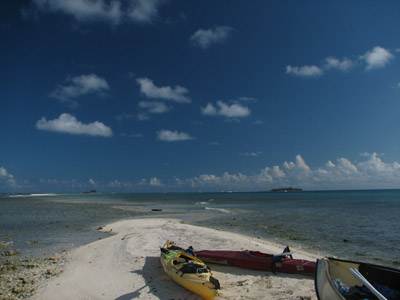
kayaks. Cayos Vivorillos, Honduras

Snorkeling was good at the Vivorillos. At the eastern edge of the barrier reef, we wound our way around in looming mazelike forests of live and dead staghorn coral. Joshua promptly spotted a “harmless nurse shark” (Joshua has taken to prefixing the word ‘harmless’ to anything that might alarm me otherwise: harmless nurse shark, harmless pit viper, harmless nuclear bomb, etc.) who slunk out of sight with a flutter of fins when we followed him. Surrounded by three other people, thus reducing my chances of being devoured to a meager 25%, the shark sighting inspired excitement and curiosity far more than nervousness or outright terror. They—that is the small harmless variety—are really very pretty fish and move with an amazing grace. I followed a black and yellow serving platter-sized angelfish who, tiring of being pursued by awkward goggle-eyed mammalian blunderers, turned sideways and disappeared into a narrow horizontal crack. We also saw swarms of tiny parrotfish, babies perhaps and zillions of them, who moved over more delicious sections of coral in a seething darting mass leaving clouds of fine Caribbean sand in their wake.

The anchorage was clear white sand evenly dotted with immense fat starfish, some with six legs that were red and orange and yellow. They stayed always about ten feet from each other. At night it was silent and with the half-moon, we could see the shadow of the boat underneath reflecting off the sand.

frigate birds and boobies. Cayos Vivorillos, Honduras

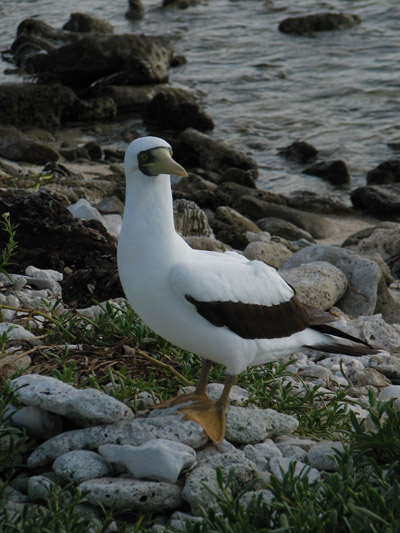
The islet at the western edge of the reef was covered in nesting frigate birds and boobies, many of whom had fuzzy white chicks. We’ve never seen this type of booby before and once again, we felt it our duty to take twelve billion photos and video as if we thought we had discovered a new species (we hadn’t; Velella’s bird book said they were Masked Boobies).

Masked Booby. Cayos Vivorillos, Honduras

We awoke the morning we were to head out for Guanaja at around 3am when the incoming fleet of sailboats came into radio range and we were forced to listen to idiotic chatter over the hailing channel. They had “buddy-boated” and maintained a distance of only a mile the entire way from Guanaja, chatting on 16 the whole way. We got the hell out of there as the boats arrived and began anchoring, all to a radio chorus of “Hey are you going to the left? Where you anchoring?” “Think we can both fit between ‘Miss Moondream Dancer’ and that reef?” “What waypoint you got for the anchorage?” It was hours before their voices finally faded into static.


Cayos Vivorillo

Monday, March 26th, 2007

It was a hard beat out of Providencia due to a sudden change in the forecast. We left anyway because we had already checked out and we like to minimize contact with the officials. The way I see it; every contact with the authorities is another opportunity to land in jail.

BIKA and Velella were leaving as well. BIKA headed north toward Grand Cayman and Cuba but Velella and TimeMachine were bound for the Miskito Coast. A midmorning departure on the 24th was timed to allow us to reach the Gorda Bank by the next morning. We gave Velella a head start but not enough and we closed on them quickly as we pounded North. We got NNE instead of the expected ENE so it was slow and uncomfortable.

By the afternoon of the 25th we were Northwest of the Arrecifa de la Media Luna and could finally fall off a little. However, it wasn’t much better. The current passes over these shallow banks flowing north against the wind which causes short steep waves. I noticed we were heeling and burying the downwind ama more than the conditions really seemed to warrant. At some point a wave had ripped off the ventilation plate on the ama and it was nearly full of water! We hove-to to pump it out. There seemed to be at least 200 gallons in there. Luckily we had an extra screw in cap for the inspection plate so we were back underway in about an hour. We learned that the boat can still sail fairly well with the downwind ama completely flooded. Also, we should remove the ventilators and seal the amas when making ocean passages.

A wet squally night brought us up to the Vivorillos at around 3 in the morning. We hove-to again to wait for light. It’s a remote and beautiful spot, but we don’t have it to ourselves. Like Providencia, it seems to be a popular stop with cruisers traveling between the Gulf of Honduras and Panama. We’d barely dropped anchor before some fishermen came by to see if we had cigarettes. “Lo siento, no fumamos.”


Isla Providencia

Saturday, March 24th, 2007

Isla Providencia, Colombia Anchorage Panorama

[We had an excellent view from our spot in the anchorage. Click for a slightly larger image.]

We slept like the dead until 10am and were halfway through our coffee before we attempted to focus our gaze beyond the perimeter of our boat and realized that our friends Velella had arrived. We hadn’t seen them since Huatulco in Mexico nearly a year before and have only been keeping in contact via email now and again. We were pretty psyched to see them and paddled over directly to harass them.

Our stay and doings in Providencia were almost unfailingly in the company of Jenni and Cameron (that’s Velella), which is generally out of character for us but in this case was quite fun as we all get along easily and eat very well when together. We did a large amount of bushwhacking, I mean hiking, inspired by information imparted to us upon check-in by Mr. Bush that there were no venomous snakes present on the island. We kept hearing rumors about “trails” that supposedly criss-cross the island but upon further inspection, every likely suspect lasted maybe 25 feet before we had to start tunneling through the underbrush. We hacked our way out on a “trail” to Morgan’s Head rock and did some snorkeling. Then we hacked our way up to some random peak on the southern end of the island where there was another “trail” to get a view.

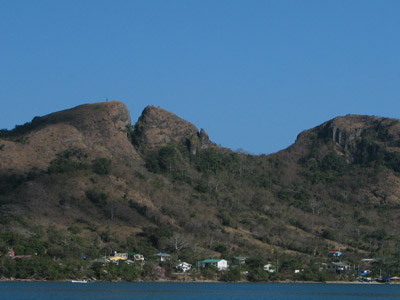
Morgan's Head. Isla Providencia, Colombia

[Morgan got his nose bit off during a raid gone awry, apparently. Also pictured is dense jungley ant-filled foliage containing approximately no trails.]

Another day we hacked our way up Morgan’s Ass, a startlingly realistic likeness I’m guessing, which sports a more official name of ‘Split Rock’ or something like that but goes locally by the former moniker.

Morgan's Ass. Isla Providencia, Colombia

All “trails” are thick with thorny bushes inhabited by the most gnarly of ant species. These ants make their home inside the fat musk ox-like thorns and run incessantly up and down the bush; if you so much as touch the bush, they know it and rush out to attack you. They are not particularly large but their bite is painful as all hell and often causes the affected area to become numb and swell for a day or two. These bushes are ALL OVER THE BLOODY ISLAND and there is simply no way around them. I have a bit of an ant phobia and these ants in their profusion had my sanity bleeding red. Especially when I brushed under a thorny bush and a few dropped inside my shirt. I was forced to do a freaky little ant dance to exorcise the biting demons and hopefully fling them far, or crush them—not sure what became of the little fuckers. It took probably ten minutes for me to not see ant-sized spots everywhere I looked.

Thorn Bushes. Isla Providencia, Colombia

[These are the bushes. They poke you too if you manage to get past the demon ant shield.]

After several days’ worth of snarfin’ wind, the snorkeling was a little murky. The goods off Morgan’s Head were so-so; more interesting stuff was out northeast of the island towards the barrier reef. We heard that there had been many nurse shark sightings and possibly a larger nurse shark. Make that some shark of unknown species. Hell, let’s just call it a bull shark. A 20-foot man-eater. Still, I was more excited about the big biters after all this ant bullshit and we hooked up the outboard to the Porta-bote for the occasion, anchoring it out in the middle of seemingly nowhere on a shallow sandy patch.

Underwater formations are different here than in the Pacific, I’m amazed to report. This probably doesn’t come as a huge revelation to the majority of sentient beings out there but with my limited snorkeling experience, I found it impressive. Here we saw fewer fish than I expected but much more coral of vastly different varieties. Ginormous lavender sea fans, long fuzzy anemone-like trees, black stark wintry coral forests, fields of sucker-plants, large mushroomy coral formations, and brain coral. Cool stuff. No sharks. We did see a gaggle of cuttle fish but they weren’t the biting variety. A rainsquall moved over us while snorkeling and the world became twilight and the rain made an interesting pattering racket as it pounded the water and the backs of our heads. Climbing back up onto the bote in the middle of the ocean was fun.

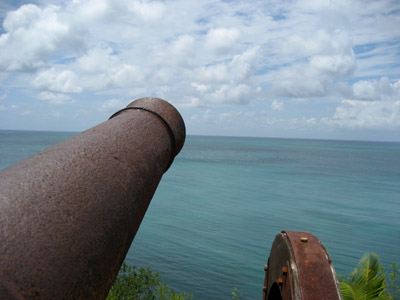
Old Canon. Isla Providencia, Colombia

[Anti-piracy device.]

The second night of our stay in Providencia, Henrik and Nina on BIKA (a 26-foot Contessa, which they sailed here from Norway) arrived and sailed upwind into the reef-encrusted anchorage after dark. Like badasses. They technically have a motor (a 4hp outboard) but they keep it stowed because their freeboard is something like six inches and any watery movement tends to swamp the thing. Therefore they always sail, which is pretty cool and very rare these days. In fact, they are the only boat we’ve ever personally encountered who absolutely always sails. It was all very Society with the dinner parties or drinks on so-and-so’s boat every night.

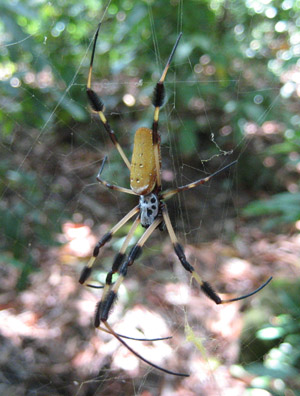
Golden Orb Spider. Isla Providencia, Colombia

[Man, have I put a photo of one of these spiders up before? Also all over the island. God only knows what would happen to you if you were bit by one of these bastards.]

After a few days of running through the activities that Providencia has to offer, we all started paying attention to the weather reports. We wanted to be moving on, Velella had family in Guatemala to meet up with in a week, and BIKA wanted to get to Cuba in order to have a decent amount of time to explore before they have to be north for the season. We all decided to leave Saturday, where there appeared to be a weather window of questionable vagueness. We sailed out and bashed as high as possible north into the wind, which was significant and not particularly cooperating, forcing us to tack to stay inside the reefy banks. We were bound for the Vivorillos with Velella but BIKA was heading north to Grand Cayman. We could see the white specs of Velella and BIKA for a while until it grew dark and we continued on as our own island in the darkness.


Cheyenne Weil, Joshua Coxwell